Get Microsoft Ads setup, tools and coupon for
  free!
free! 


Averages lie. While you look at a satisfactory overall ROAS of your P.Max campaign in the ads manager, in the background, your budget is being quietly drained by products that should have received a different label a long time ago.
But they couldn’t. They had to wait for the conditions to be met for the entire campaign. Your best product was paying the price for your worst one.
As of today, this is OVER.
At BlueWinston, we took our proven P.Max ROAS Labelizer, which saves e-shops thousands of euros daily, and completely revamped its logic.
We are abandoning the global portfolio evaluation. We are moving to detailed micromanagement at the level of every single product.
What exactly have we improved, and how will this new level of precision change the performance of your campaigns?
From the big picture to the details
You might remember our article titled: Frequent labeling decreases P.Max performance. We have a solution, in which we introduced an intelligent automatic mode.
This approach worked great and brought excellent results. However, the data showed us that we can go even deeper.
Some specific products can gather enough data much faster and are ready for a label change (and thus a strategy change) sooner than the rest of the products in the campaign. That is why we decided to push this system to perfection.
Every product plays for itself
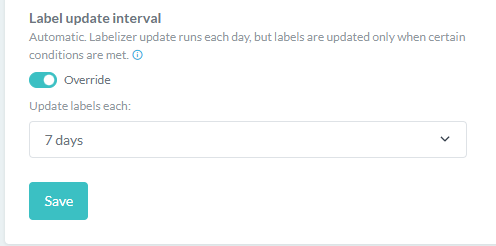
From now on, the system no longer waits for a “global” signal from the entire portfolio. Whether a product gets a new label depends solely on its own performance. Our Labelizer continues to run in its regular 24-hour cycle, but it introduces an update schedule based on product activity:
- High activity (large fluctuations):
The product is checked and re-evaluated every day. - Medium activity:
The product is checked every 3 days. - Stable products:
The check takes place once every 7 days.
At the same time, we have built a 5-day label protection into the system. This means that if a product receives a new label, the system will not change it for the next 5 days (with the exception of truly extreme changes in performance). This protects your campaigns from constant label switching, which would confuse Google’s algorithm.
You can find these new decision-making rules transparently described at any time in the tooltips directly within the user interface.

What else does this massive update bring?
Besides the new background logic, we have added a series of features to the Labelizer interface that will give you absolute control over labeling.
Transparency with Product Details (Aside box)
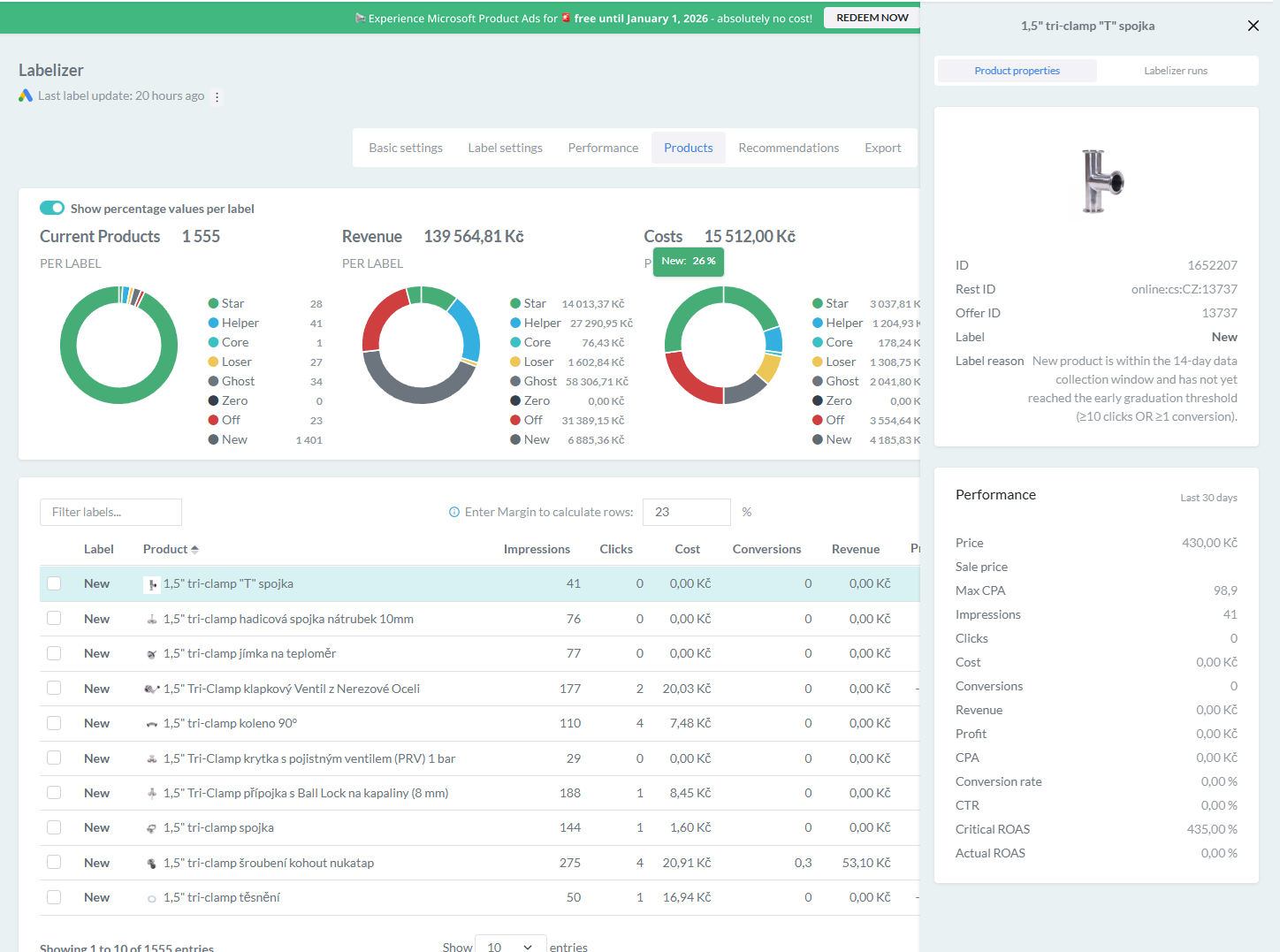
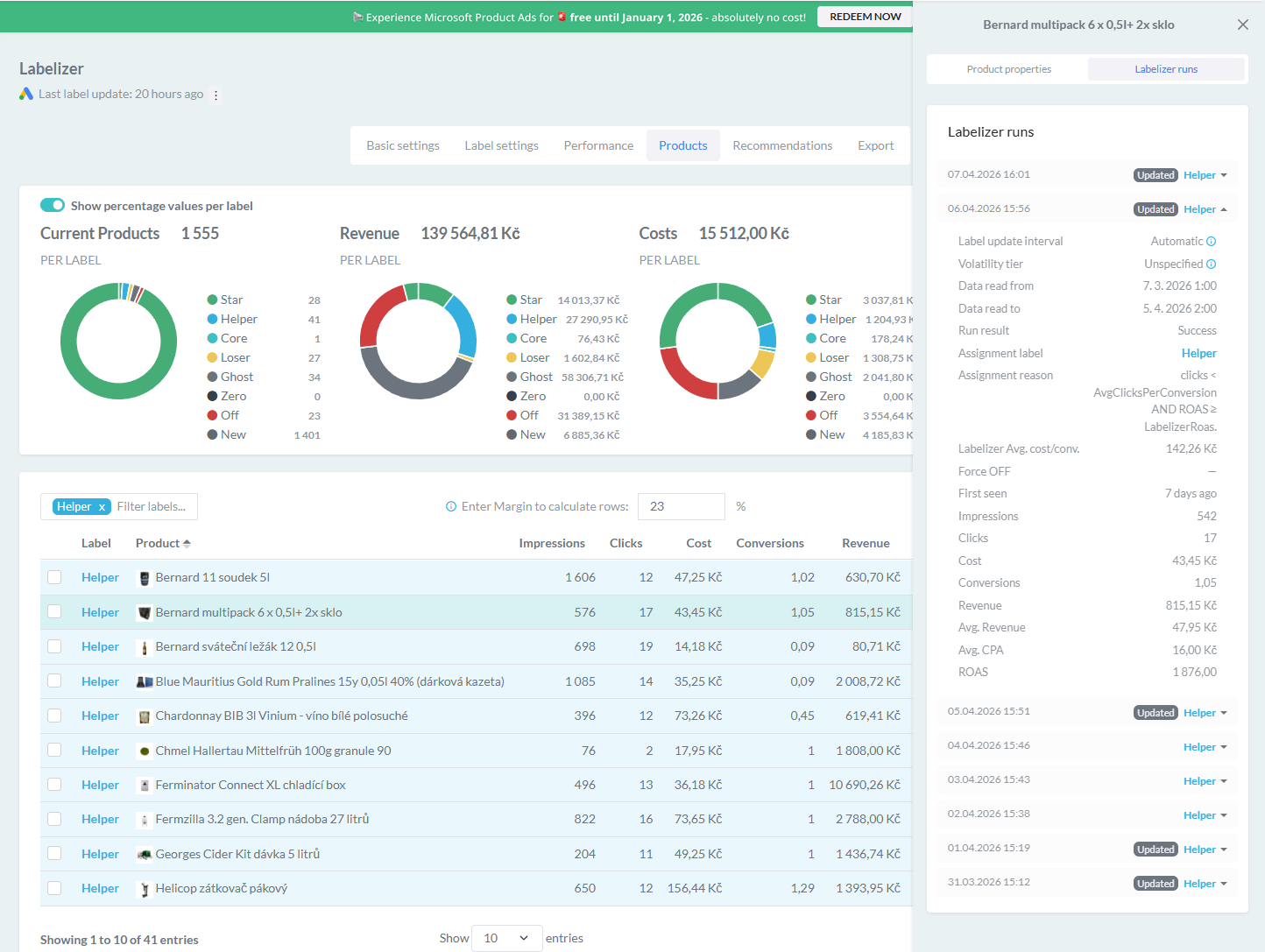
We want you to see exactly what the system bases its decisions on. Upon clicking on any product, a new side panel will slide out with two key tabs:
- Product properties
A quick summary and basic information about the product.
- Labelizer runs
Here you will see a detailed history of the last 8 Labelizer updates for the given product.

You can click on each system run to see the exact metrics and values from which our algorithm calculated the final label. This gives you a bulletproof overview of every single step the system takes.
Immediate reaction to a change in your strategy
The market is changing, and you need to react quickly. If you decide to adjust the key settings of the Labelizer (for example, you tweak the Margin (%), Labelizer %ROAS, Average Clicks, Time frame, or toggle Use Zero label), you no longer have to wait.
The system automatically forces a recalculation and an immediate label reset based on your new rules. A clear visual indicator will alert you to the ongoing update.

“Force Update”: Control in your hands
Do you need to update the labels here and now, outside the regular cycle?
We have added a new button for an immediate, manual forced label update. However, to protect P.Max campaigns from unnecessary overloading due to oversight, we secured this feature with a protective cooldown of 6 hours.

PLUS – we improved the at-a-glance clarity. The Labelizer header no longer displays just the technical data of when the hidden background update occurred. Now, you see much more important information there: the exact time when the last physical setting or change of any label actually took place.
Welcome the brand-new “New” label
We also thought about the expansion of your inventory. Our portfolio is growing with a new type of label marked “New”.
It is designed specifically for smarter handling of products that have just been added to your feed. It gives these products up to a 14-day protective data-gathering period so they aren’t immediately thrown into a poor-performing category just because they lack history. However, if a product proves its potential earlier (gathers 10 clicks or 1 conversion), it immediately leaves the protection and receives its actual label.
Quick overview of changes

Conclusion
From now on, the P.Max Labelizer is not only fully automatic but, above all, micro-analytical.
Thanks to the transition to individual product evaluation and historical records, you get a tool that not only saves hours and days of manual work but also reacts to the performance of your campaigns with “surgical” precision, thereby protecting your budget.
Do you want to streamline your P.Max campaigns and test on your own data how this per-product logic will skyrocket your results?
You can try the P.Max ROAS Labelizer completely for free for 30 days.
All you need to do is register.