Get Microsoft Ads setup, tools and coupon for
  free!
free! 


It seems everyone today is focused on performance…
…and in PPC advertising, Performance Max is the symbol of performance.
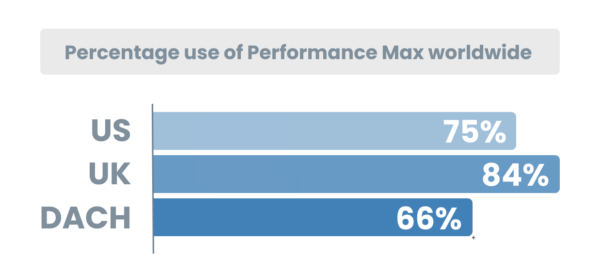
According to available data, this campaign type is used by nearly three-quarters to more than four-fifths of e‑shops (i.e., 75 % of e‑shops in the USA, 66 % in the DACH region, 84 % in the UK).
Source: Channable
But here’s the critical question: how many of these campaigns are actually effective?
Automated campaigns can manage bidding and placements across networks, but without intelligent product segmentation and data optimization, advertisers risk a large portion of their budget flowing through the system without generating adequate performance.
Performance Max is a powerful tool, but its results are not automatically maximized. The algorithm can optimize impressions, bidding, and budget, but if products with low or zero performance are included in the feed, the campaign will subconsciously optimize for the average, which in e‑commerce translates to a reduced ROAS.
True campaign effectiveness comes from working at the individual SKU (Stock Keeping Unit) level, evaluating:
- Historical performance
- Margin
- Product price
- Number of interactions
- Conversion rate
This allows precise identification of which products drive campaign performance and which hold it back.
Key to Performance
1. Segmentation
The key to success is advanced product segmentation. Products should not be treated as a uniform mass but divided by potential:
- Top products – stable sales, high ROAS, strong historical performance
- Growth potential products – low sales volume but suitable for budget increases
- Low-performing products – high spend, low conversion; these are paused or optimized
Segmentation enables you to focus budget where it delivers the highest ROAS and minimize waste on products that drag the campaign down.
2. Data Optimization
Effective segmentation goes hand in hand with data optimization. In P.Max campaigns, performance tracking cannot be limited to overall revenue or campaign-level conversion rate.
Each product must be analyzed individually:
- SKU-level performance analysis – identify products with the highest ROAS or conversion rate
- Automatic pausing of low-performing products – prevents budget waste
- Dynamic budget adjustment – allocate funds to high-performing products
- Segmentation by margin and price – not everything that sells is profitable
Working with this data allows not only optimization of budget and bidding but also informed decisions about which products will move the campaign forward and which are better paused.
How to Create High-Performing P.Max Campaigns
As we already mentioned, when creating high-performing P.Max campaigns, it is crucial that products are not treated as one unified mass.
It is necessary to work with individual SKUs, evaluate historical performance, and segment products according to their contribution to the overall ROAS. The budget is then shifted to high-performing products, low-performing products are paused, and campaign targeting is optimized based on data from multiple channels — not only from Google or Microsoft Ads, but also from organic and social sources.
In practice, this means that the performance of P.Max campaigns depends on a combination of intelligent segmentation, data-driven optimization, and continuous performance monitoring at the product level. This approach transforms P.Max campaigns from automated ad sets into a truly effective performance management tool.
All-in-One Solution
All of this can be managed efficiently using BlueWinston.
→ Enhanced P.Max Campaigns with BlueWinston
If you want to maximize P.Max efficiency without unnecessary manual work, BlueWinston simplifies the process:
Create Google and Microsoft P.Max campaigns
Manage and create Performance Max campaigns for both Google Ads and Microsoft Ads in a single interface, without switching platforms, using unified product data logic.

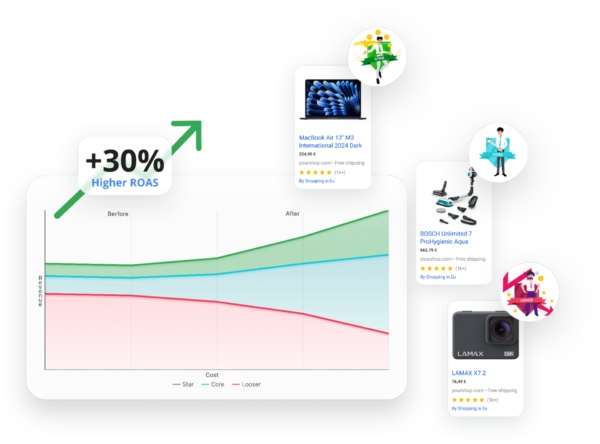
Optimizes campaigns based on product historical performance, price, margin, and keyword occurrence. The system automatically prioritizes high-potential products and limits budget on lower-performing items.
Advanced Filtering
Customize targeting to reach the right audience and advertise only products that make economic sense. Filter by category, brand, price, margin, or multiple criteria simultaneously.
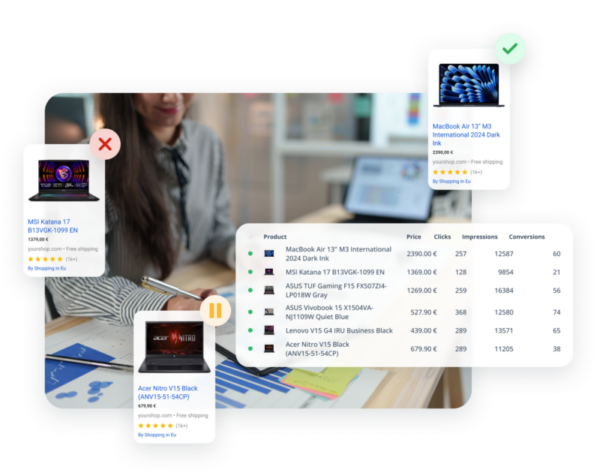
The system can automatically pause low-performing products that spend budget without conversions, or adjust campaign budgets for high-performing products. Optimization is continuous and data-driven.

Reports and Transparency
Clear reporting enables quick evaluation of campaigns in terms of spend, conversions, ROAS, CPA, and conversion rate. Filters make it easy to identify weak products and respond with further optimization.
With BlueWinston, managing Google and Microsoft Ads P.Max campaigns becomes simple and efficient.