Get Microsoft Ads setup, tools and coupon for
  free!
free! 


Many e-commerce stores start advertising by simply “uploading the entire feed” into the ad system and waiting to see what happens. Google or another platform will supposedly figure it out.
And it will… about as well as if you dumped all the books in a library into one pile and hoped the librarian would always find the right one.
Advertising without segmentation is like a library without a system
In practice, this often means some products consume most of the budget without visible results, others appear in ads only occasionally, and the e-shop owner has no idea why. The ad system works with data, but without a clear structure, it lacks the context needed to make better decisions.
The problem usually isn’t the platform itself, but how the products are prepared and divided before launching campaigns. This is where product segmentation plays a key role – the fundamental building block of effective, scalable, and long-term sustainable advertising.

What Is Product Segmentation?
(And Why It Shouldn’t Be Confused with Other Concepts)
Product segmentation means dividing your e-shop products into groups based on their characteristics, performance, or business value. It’s not just about “keeping data organized” – it’s a strategic decision that directly affects how campaigns perform.
It’s important to clarify one thing: we’re not talking about market or customer segmentation. That’s a completely different discipline.
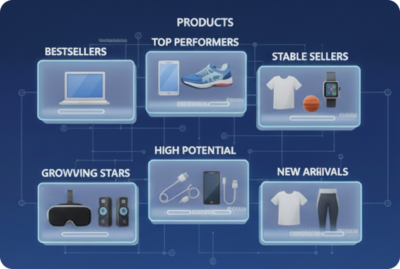
Product segmentation answers the question what you advertise, not to whom. In advertising systems like Google Ads, this distinction is crucial because products are the core unit of optimization in Shopping and Performance Max campaigns.
Why Proper Product Segmentation Has Such a Big Impact on Results
When an ad system sees all products as one mass, it optimizes toward the average. And in e-commerce, the average is often the worst possible outcome. Segmentation allows advertising algorithms to better understand which products have potential, which are key revenue drivers, and which require a more cautious approach.
For advertisers, this means better budget control, clearer decision-making, and the ability to strategically support products that truly move the business forward. It also significantly simplifies performance evaluation – instead of just looking at the “overall e-shop ROAS,” you can see which segments drive growth and which hold it back.
How to Segment Products in a Meaningful Way
Performance-Based Segmentation
Separating stars from the rest of the catalog
One of the most effective approaches is dividing products based on their actual performance. Some generate steady conversions, others sell occasionally, and some are practically invisible in ads.
If you leave them all in one campaign, strong performers end up “carrying” weaker ones…
Segmentation allows you to create a dedicated space for bestsellers, giving them more budget, more aggressive bidding, and faster algorithm learning. Underperforming products won’t drag down overall results but will receive exactly as much attention as they deserve.
Segmentation by Product Attributes
A foundation you can build on
When launching ads, you often don’t yet have enough performance data. In that case, it’s ideal to segment based on product attributes – category, brand, price range, or assortment type.
This form of segmentation is simple, clear, and easy for advertising systems to interpret. It also creates a strong foundation that you can later enhance with performance – or margin-based segmentation. It’s like organizing books in a library by genre – you may not know which titles are most popular yet, but at least you know where to find them.
Margin-Based Segmentation
When performance isn’t enough
Not every sale has the same value. High revenue doesn’t automatically mean high profit. Margin-based segmentation helps you distinguish between products that sell well but bring minimal profit and those that are truly key for your business.
This approach is especially important in automated campaigns, where systems optimize primarily for performance, not profit. Without margin segmentation, you might unknowingly support products that look successful but don’t actually contribute to company growth.
Dynamic Segmentation
When data works for you
More advanced e-shops use dynamic segments that change based on real-time data from ad systems or analytics tools. Products can automatically move between segments depending on ROAS development (see our P.Max ROAS Product Labelizer), number of conversions, or seasonal trends.
This approach allows you to respond to customer behavior changes without manual intervention and creates a solid foundation for effectively leveraging automation and AI in advertising.
How to Approach Segmentation Correctly from the Start
When launching ads, it’s crucial to begin with clearly defined rules. Here’s a mini checklist:
- Ensure high-quality product data
- Define clear product segmentation criteria
- Implement segments into feeds and campaigns using custom labels
It’s important to treat segmentation as a living process, not a one-time setup. Products evolve, seasonality shifts, performance fluctuates – and segments should evolve accordingly.
How BlueWinston Helps with Product Segmentation
At BlueWinston, we work with product segmentation every day. We know that manual product labeling is time-consuming and often inaccurate, which is why we offer tools that significantly simplify the entire process.
- P.Max Product Labelizer automatically evaluates product performance based on multiple factors such as click-through rate, interactions, and ROAS. It then creates clear custom labels for Performance Max campaigns based on predefined rules.


- GA4 Labelizer goes even further. It doesn’t rely on data from just one ad system – it collects product performance data across channels in Google Analytics 4. In practice, this means you can identify products that perform best on Facebook or another traffic source and use this data when building Google Ads campaigns.


product sells well on one channel, GA4 Labelizer helps you leverage that signal elsewhere. Instead of guessing what might work, you operate based on real user behavior and actual results.
- Margin Labelizer focuses on product profitability, not just performance. It works with margin data from your e-shop and automatically labels products based on the real business value they generate. This allows you to differentiate high-, medium-, and low-margin products in campaigns and adjust budgets and bidding accordingly. The ad system then optimizes not just for sales or ROAS, but for what truly makes sense for your business to sell.


The result is advertising with structure, logic, and room to grow – just like a well-organized library where every title knows exactly where it belongs.
If you want your campaigns to work systematically instead of randomly, BlueWinston and its extensions can significantly help you with product segmentation.