Get Microsoft Ads setup, tools and coupon for
  free!
free! 


A campaign with a ROAS of 5:1 (500%) may look like a jackpot — but in reality, it can be unprofitable.
How is that possible?
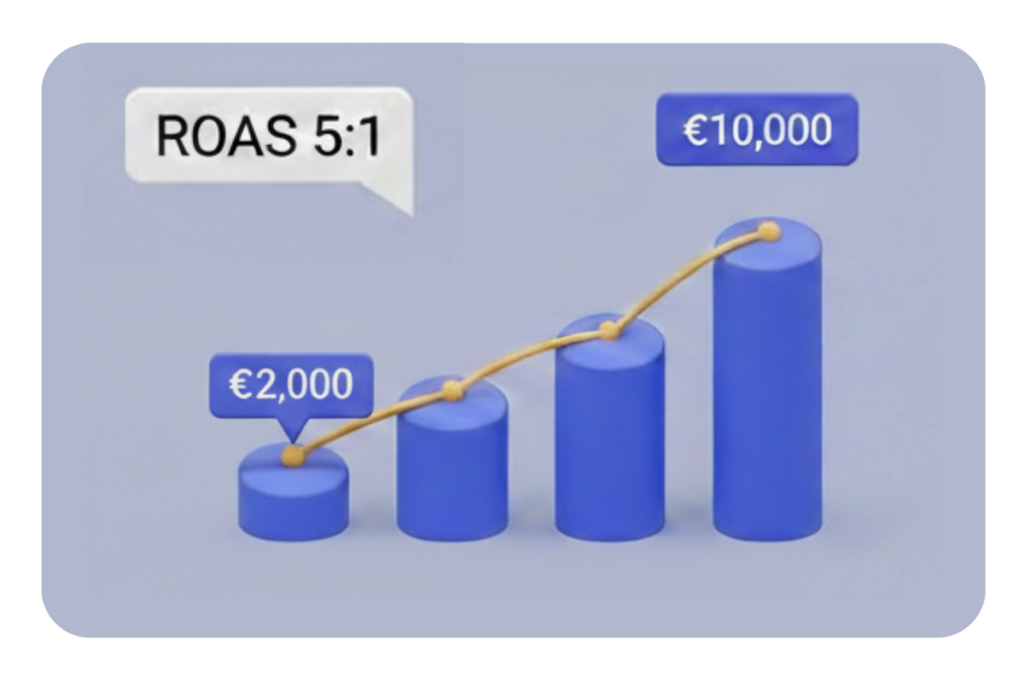
ROAS (Return on Ad Spend) measures only the revenue generated by advertising relative to the cost of that advertising. So if you invest €2,000 into a campaign and it generates €10,000 in revenue, your ROAS is 5:1.
Sounds great, right?
But what if the products you sold have low margins and shipping or other variable costs consume most of the revenue?
In that case, the campaign looks successful based on ROAS but profit is minimal or even negative.
That’s exactly why it’s important to pay attention to another metric: POAS (Profit on Ad Spend).
What Is ROAS and Why Is It Used?
ROAS (Return on Ad Spend) is one of the most widely used metrics in digital marketing. Its purpose is to answer a basic question: how much revenue does advertising generate for every euro invested? It’s a quick indicator of campaign efficiency from a revenue perspective – not a profit perspective.
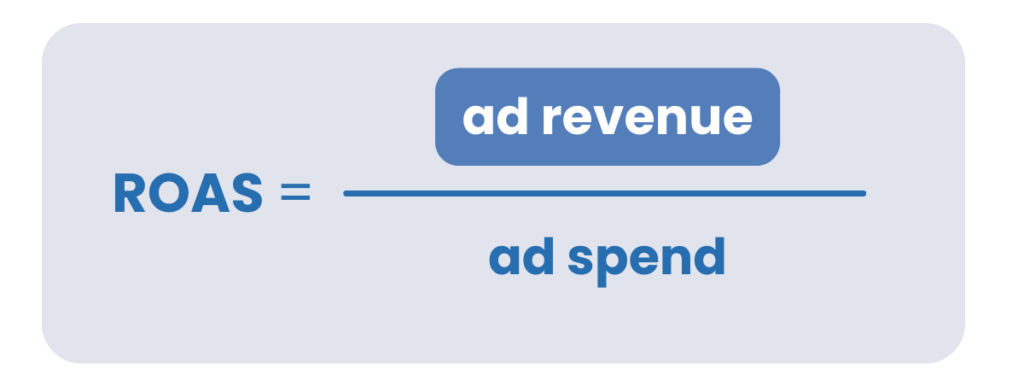
As mentioned earlier, if you invest €2,000 into a campaign and it generates €10,000 in revenue, your ROAS is 5:1, or 500%. At first glance, this looks like clear proof of success.
ROAS can tell you that advertising is generating revenue efficiently and that some campaigns drive higher turnover than others.
The problem arises when you evaluate performance exclusively through ROAS. This metric does not consider whether you actually made money. It does not include product costs, shipping, warehousing, discounts, returns, or payment fees. As a result, ROAS may look excellent – but with low margins, the campaign can actually be loss-making.
What Is POAS and Why Is It More Important?
POAS (Profit on Ad Spend) takes things a crucial step further. Instead of focusing on revenue, it measures the actual net profit generated by advertising after deducting all relevant costs. This provides a much more accurate picture of real campaign performance from a business perspective.
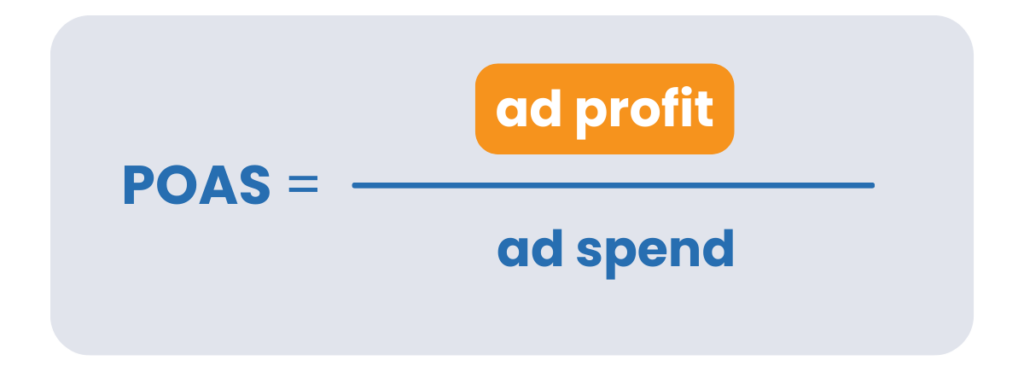
In this case, profit does not only mean the difference between revenue and advertising costs. It refers to revenue reduced by COGS (cost of goods sold) and all variable costs, such as shipping, packaging, payment fees, or discounts.
So:
- If POAS is higher than 1, every euro invested in advertising generates net profit.

- If POAS is lower than 1, it means that even with growing revenue, the e-shop is actually losing money.

That’s why POAS better reflects true business performance. POAS captures the real impact of advertising on profitability, allows you to prioritize higher-margin campaigns, and reveals situations where campaigns look good based on ROAS but fail to generate real value.
Important to REMEMBER:
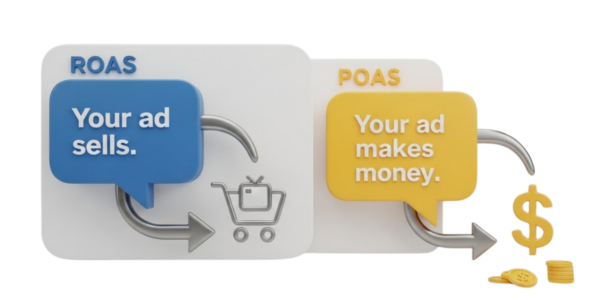
ROAS says:
“Your advertising is selling.”
POAS says:
“Your advertising is earning.”
In Short: ROAS vs. POAS
…Two Perspectives on the Same Problem
ROAS and POAS may appear similar, but they answer completely different questions.
Why Is the Market Naturally Shifting Toward POAS?
As competition increases, customer acquisition costs rise and margins shrink. In such an environment, e-shops can no longer optimize campaigns based solely on revenue. Automated campaigns, such as Performance Max, often prioritize higher-priced products — not necessarily more profitable ones.
POAS allows you to scale campaigns intelligently. It helps you invest only in segments with real profit potential and reduce wasted budget on products or campaigns that sell but do not earn.
How to Start Measuring POAS Technically
1️. Conduct a Cost Audit
- COGS (product cost)
- Shipping and packaging
- Payment fees
- Discounts or returns
2. Integrate Data into Analytics
- GA4, Google Sheets, or a BI dashboard
- Track profit, not just conversions
3. Optimize Campaigns Based on POAS
- Adjust bidding, reporting, and dashboards according to POAS
- Prioritize higher-margin products
Conclusion
POAS as a necessity, not an alternative…
ROAS remains a useful metric for evaluating sales volume. However, in today’s competitive e-commerce environment, net profit is what truly matters. POAS enables intelligent budget allocation, scalable profitability, and reduced waste.
“ROAS tells you that advertising is selling. POAS tells you whether it’s actually worth it.”
For an e-shop that wants to grow profitably – not just quickly – POAS is not an alternative. It’s a necessity.