Get Microsoft Ads setup, tools and coupon for
  free!
free! 


Valentine’s Day is ramping up – your competitors are already capturing billions, and you’re still scrolling?
Does this sound like clickbait? Maybe. But it’s not far from the truth.
In the US alone, Valentine’s Day spending is expected to reach a record ~$29.1 billion in 2026, more than ever before – with online shopping accounting for a significant share of this “love economy” moment.
And while most of us are still counting down the days to Valentine’s Day, brands are already collecting data, planning campaigns, and competing for attention well before the holiday season even begins.
For example, Microsoft Advertising found that up to 61% of Valentine’s Day conversions come from clicks that happened in December and January. This clearly shows that Valentine’s Day is a long purchase funnel, not just a few days of last-minute shopping.
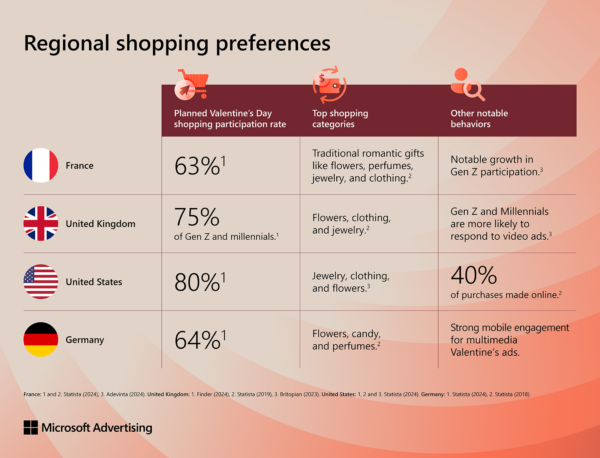
What does this mean for your e-shop?
If you want to sell, you need to target at the right time and set up your campaigns correctly
People are already in buying mode
The week before Valentine’s Day is no longer about “inspiration.” It’s the decision-making phase.
Customers:
- already know they want to buy a gift
- compare specific products
- focus on delivery, availability and certainty
- often buy impulsively, but with a clear goal
For e-shops, this creates an ideal environment: high purchase intent, fast decision-making, and a willingness to pay more if customers feel they can still make it in time.
Google Ads: capture intent that’s already there
Search campaigns: less creativity, more precision
At this stage of Valentine’s Day, the winner isn’t the one shouting “discount,” but the one who answers the search intent most accurately.
- “Valentine’s gift for her / for him”
- “best Valentine’s gifts”
- “personalized gift”
- “delivery by Valentine’s Day”
- “pickup today”
That’s why search campaigns should be segmented by intent. The mindset of someone browsing gift ideas is very different from someone checking whether a package will arrive on time.
Responsive Search Ads (RSAs) should combine who the gift is for the product’s key benefit, proof points such as reviews or popularity and most importantly, delivery and availability certainty
Shopping: decisions made in seconds
Shopping campaigns are extremely powerful during Valentine’s Day, but only if your feed works in your favor. What matters most are clear product titles with a gift-related context, clean and uncluttered images, visible delivery information, and customer trust built through reviews, packaging, and return options.
When customers are choosing between five similar products, the one that creates the least decision stress often comes out on top.
Performance Max: scaling, but with control
Performance Max helps capture broader demand, but it’s important to ensure that:
- creatives clearly communicate availability and certainty
- asset groups aren’t mixed (budget vs. premium vs. last-minute products)
- remarketing audiences receive different messaging than new users
Microsoft Ads: less competition, often cheaper clicks
Microsoft Ads is often underestimated during Valentine’s Day – and that’s exactly why it’s interesting.
Local and “near me” searches
Such searches are becoming increasingly common, including:
- “delivery near me”
- “local gift delivery”
- “Valentine’s gift + city”
If an e-shop can deliver quickly or offers local pickup, this is a major competitive advantage that should be clearly communicated.
Audience Ads: reach the right people at the right moment
Audience Ads allow you to work beyond traditional search, especially with younger audiences, including Gen Z, users who have already shown interest in gifts, audiences in a “browse & decide” mindset. Visual reminders, decision support, and gentle nudges toward purchase perform exceptionally well here.
Multimedia Ads: emotion works
Multimedia Ads leverage Valentine’s Day emotions. Images and headlines show the product in a gift context, communicate “this is the right gift,” and encourage impulse decisions — especially on mobile.
In the final week before Valentine’s Day, demand can change day by day. Automated bidding strategies help maintain competitive positions, react quickly to CPC fluctuations, eliminate the need for constant manual adjustments
- Separate campaigns by search intent
- Communicate delivery certainty everywhere possible
- Fully leverage Shopping and visual ad formats
- Don’t ignore Microsoft Ads – it can be powerful and cost-efficient
- Monitor performance daily and optimize fast
Where does BlueWinston fit in?
Periods like Valentine’s Day are exactly when it makes sense to have everything in one place. With BlueWinston, you can:
With BlueWinston, you can create and manage campaigns across Google Ads and Microsoft Ads, use automated bidding strategies, quickly optimize campaigns based on performance, track data and results in a single interface
You can try BlueWinston free for 30 days and get immediate access to all its features. Start today – it can genuinely pay off before Valentine’s Day.
Conclusion
Valentine’s Day isn’t about who offers the biggest discount. It’s about who gets intent, timing, and execution right. And that’s exactly what modern campaigns – and tools like BlueWinston – are built for.