Get Microsoft Ads setup, tools and coupon for
  free!
free! 


Growing revenue in e-commerce is often perceived as proof that a company is moving in the right direction. More orders, higher revenue, better ROAS in advertising systems – at first glance, everything looks healthy.
And yet today, it’s completely common for an e-shop to grow… while actually losing money.

This isn’t necessarily because they make major marketing mistakes, but because they evaluate performance primarily through revenue and surface-level metrics rather than profitability. Decisions that make sense at the campaign or revenue level can, in reality, slowly, systematically, and quietly erode margin – order by order.
This brings us to two concepts that form the foundation of every healthy business but often remain just an “accounting formality”: Cost of Goods (COGS) and margin.
What Is Cost of Goods (COGS)?
…and Why It’s the Foundation of Everything
Cost of Goods Sold (COGS) represents the direct costs of goods or services that were actually sold during a given period.
These are costs that arise before marketing, advertising, or growth even come into play.
COGS includes:
- purchase price of goods or raw materials
- direct production costs
- logistics related to procurement
- direct labor in production
It does not include:
- marketing costs
- administrative salaries
- rent
- software tools
Confusing these categories is a common reason why companies don’t truly know how much their products cost.
If you don’t know your COGS precisely, you don’t actually know whether you’re making money at the product level. And if a product doesn’t even cover its direct costs, no campaign optimization will save it.
What Is Margin? …and Why Margin ≠ Profit
Margin is the difference between the selling price and COGS, expressed as a percentage of revenue. It doesn’t tell you how much you earn – it tells you how much remains to cover everything else: marketing, shipping, returns, payment fees, salaries, and technology.
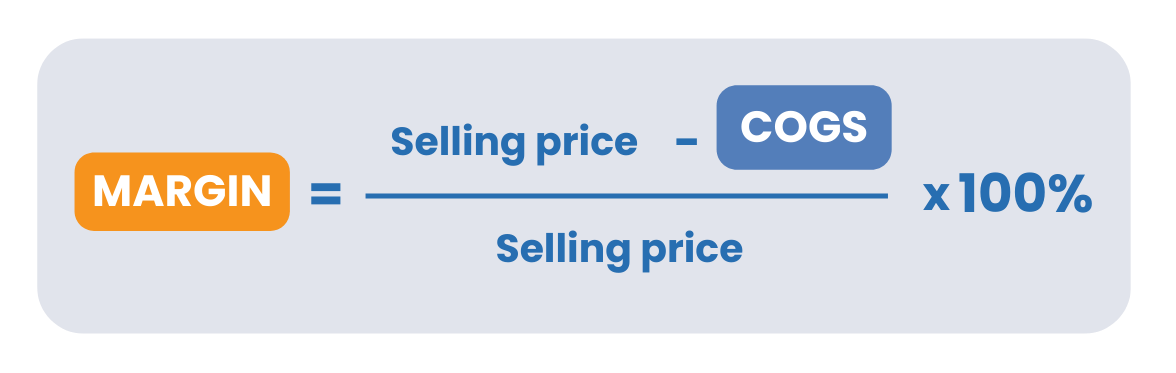
If you sell a product for €100 and its COGS is €70, your margin is 30%. That €30 must cover everything else… and only what remains after that is actual profit.
Why Revenue Growth Often Creates Only the Illusion of Profitability
Margin pressure today isn’t driven only by marketing, but also by logistics.
In its analysis, McKinsey points out that fulfillment costs – warehousing, packaging, and delivery – can account for approximately 12–20% of revenue.
In other words, if an e-shop generates €100,000 in monthly revenue, €12,000–€20,000 may already be “consumed” by fulfillment alone. And that doesn’t yet include marketing, discounts, returns, or operational expenses.
The result is paradoxical but very common: a company increases revenue, invests more in advertising, processes more orders… while its margin simultaneously shrinks. Profitability often exists more on paper than in reality.
This clearly shows that revenue or ROAS alone is not enough. They show that you’re selling – but not whether it’s worth it. And that’s where control over COGS and margin becomes crucial.
How to Work with Margin and COGS in Practice
COGS and margin cannot remain just accounting terms. They must become active inputs in decision-making. Every product has a different cost structure, different margin, and different ability to absorb marketing costs.
- High-margin products provide room for more aggressive advertising, testing, and scaling.
- Low-margin products require strict cost control, careful pricing, or a completely different business approach.
Without this distinction, algorithms optimize for volume, not for value.
Conclusion
- COGS tells you how much a sale costs you.
- Margin tells you how much you can still afford to spend.
In an environment where average e-commerce margins hover around 10% and fulfillment alone can consume up to one-fifth of revenue, it’s no longer enough to know that your e-shop is growing.
What matters is whether it’s growing profitably.
And that’s why margin is not just a number in a spreadsheet. It’s the difference between an e-shop that looks successful and one that is truly sustainable long term.