Get Microsoft Ads setup, tools and coupon for
  free!
free! 


If someone asked you: “Which products are truly making you money today?”
Would you know the answer? … Or would you just be guessing?
You might be one of those making decisions blindly – without even realizing it.
According to data, only 54% of companies today claim they make decisions primarily based on data and insights. Nearly every second organization — including e-commerce brands — still combines data with intuition or relies entirely on “gut feeling” when making key business decisions.
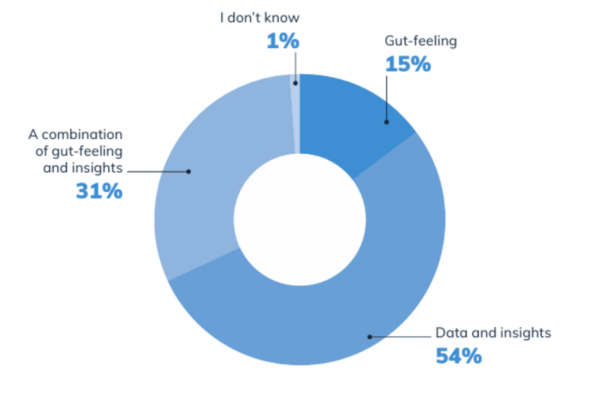
Source: Board.com
In the e-commerce environment, this approach has very concrete consequences. Many owners and managers see overall revenue but cannot clearly identify which products are truly driving performance, which are simply consuming budget, and which have potential but never received proper exposure.
Without this level of clarity, investments in advertising, inventory management, or product decisions are made blindly.
Why Is It Worth Tracking Product Performance?
This is exactly why monitoring individual product performance is crucial. Product-level analysis helps you understand which:
- products convert best
- products are associated with higher average ratings and repeat purchases
- SKUs consume budget without performance
- products need optimization or should be removed from advertising
And this is where the term bestseller gains real meaning. These data points clearly show which products in your e-shop perform – and which don’t – not just based on sales, but as a verifiable performance signal.
Bestsellers Are Not Just “Top-Selling Products”
Bestsellers are not just a marketing label. They are products whose performance is backed by data and that provide clear input for decisions about budgets, campaigns, or inventory priorities.
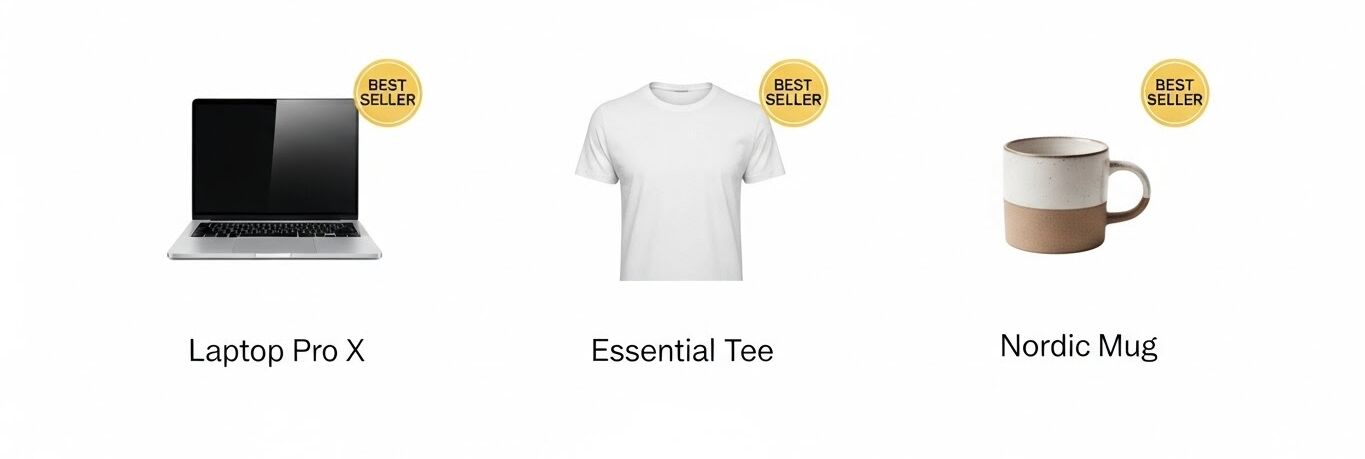
- has stable sales performance over time (not just a one-time spike),
- has a higher conversion rate than the catalog average,
- significantly contributes to total revenue or profit,
- shows strong historical performance in advertising and analytics systems.
Why Bestsellers Determine E-commerce Success
Knowing your bestsellers isn’t just important for internal management. It directly impacts customer behavior and conversion rates.
1. Influence on Customer Decision-Making
Customers don’t have to browse dozens of similar products. A “bestseller” label guides them toward a proven choice, reducing decision paralysis, shortening the path to purchase, and accelerating checkout.
2. Social Proof Increases Trust
A “Best Seller” badge or section acts as a powerful social proof signal. Especially for new visitors, it increases confidence that the product has been repeatedly purchased and validated by others, increasing the likelihood of purchase.
According to MolStud, up to 30% of consumers state they are more likely to purchase a product if it is presented as popular or trending – for example, labeled as a “Best Seller.” That means nearly 1 in 3 buyers is directly influenced by seeing that others are purchasing the product or that it is considered popular.

3. Psychological Effects and AOV
In addition to increasing conversions, bestsellers often lead to higher average order value (AOV). When purchasing a bestseller, customers are more likely to add additional items (cross-sell, bundling), increasing total revenue.
These effects are not just marketing phrases. On the contrary, they represent core business insights that complement traditional e-commerce KPIs such as conversion rate, average order value, and individual product sales performance.
Why Most E-shops Don’t Actually Know Their Bestsellers
In practice, we see that most e-shops evaluate performance too broadly. Often, an e-shop uploads the entire product feed into an advertising system and then simply waits to see what happens. They don’t know their product segments, they don’t evaluate product-level performance, and they hope automated campaigns will work miracles.
Typically, they only monitor:
- overall e-shop revenue
- performance at the campaign level (not product level)
- average ROAS without SKU-level insight (Stock Keeping Unit)
The result? Strong-performing products get mixed with weak ones. Algorithms optimize toward the average → and in e-commerce, the average is almost always the worst possible outcome.
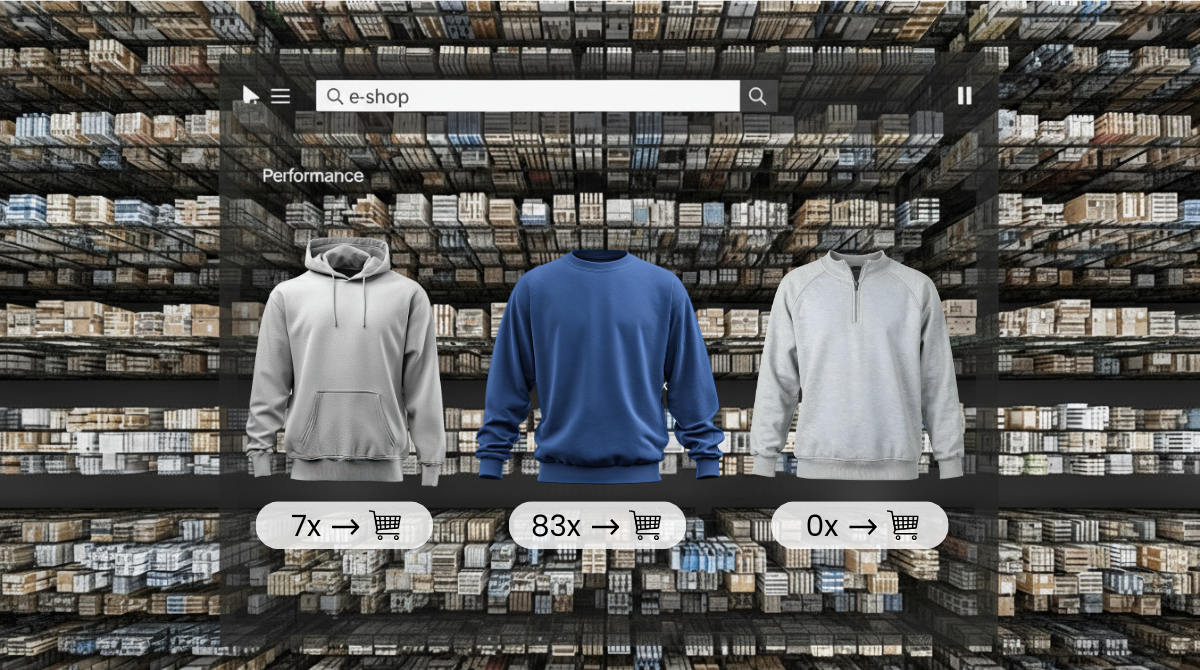
In automated campaigns like Shopping or Performance Max, products with strong historical performance naturally gain an advantage. They receive more impressions, a larger share of the budget, and more algorithmic trust.
However, if bestsellers are not identified, separated, and managed independently, the e-shop loses control over them. The algorithm may “know” which products are strong — but you cannot strategically work with them.
That’s why products need to be evaluated at the individual SKU level and monitored systematically. This approach ensures decisions are based on data, not feelings, and provides clear signals about which products are truly driving the business.
How to Identify Bestsellers Technically and Through Data
For a bestseller to be a fact – not a feeling – you must work with product-level data. Key metrics include:
- number of units sold within a defined period (week, month, quarter)
- product page conversion rate compared to catalog average
- share of revenue and profit,
- advertising campaign performance (e.g., CTR, ROAS at SKU level)
- cross-channel user behavior data
It’s important to compare products against each other, monitor their development, and treat them as segments — not as one mass.
How We Approach This at BlueWinston
With smaller catalogs, it’s still possible to evaluate this data manually. But with hundreds or thousands of products, visibility is quickly lost and decisions come too late. That’s why high-performing e-shops use automated tools that continuously and systematically evaluate products.
At BlueWinston, we faced this problem daily — which led to the creation of Labelizers, tools that take control of product data and enable systematic monitoring.
- P.Max Product Labelizer monitors each product’s performance in Performance Max campaigns across multiple metrics — from interactions and clicks to ROAS. Based on this data, it automatically creates structured custom labels that determine which products receive dedicated budgets and optimization priority. The result? Strong products receive clearly defined support — and you gain full visibility over budget allocation.
- GA4 Labelizer goes one step further. It doesn’t rely on data from just one platform – it collects product insights across all channels in GA4. This means you can identify products that perform best on organic or paid channels — such as Facebook, Instagram, or other traffic sources — and use this data when setting up campaigns in Google Ads.
Simply put, GA4 Labelizer transforms product performance on one channel into a measurable signal that you can leverage across all advertising activities. Instead of guessing what will work, you operate with concrete customer behavior data and clearly know which products will move your e-shop forward.
- Margin Labelizer focuses on the real profitability of products, not just their sales performance. It uses margin data from the e-shop and automatically labels products based on the actual value they bring to the business. This allows you to easily distinguish between high-, medium-, and low-margin products in your campaigns and adjust the budget and bidding accordingly. As a result, advertising systems optimize not only for the number of sales or ROAS, but also for which products are the most profitable for the e-shop.
Conclusion
Bestsellers are not just a homepage feature. They are the strongest products within your e-shop’s data ecosystem.
When you know your bestsellers, you know exactly where to allocate budget, which product segments to scale, and where to optimize feeds, pricing, or advertising.
On the other hand, without this information, you make decisions based on feeling rather than real data… and let’s be honest – in e-commerce, that’s a fast track to stagnation.
→ And that’s exactly why bestsellers are a must-know.